
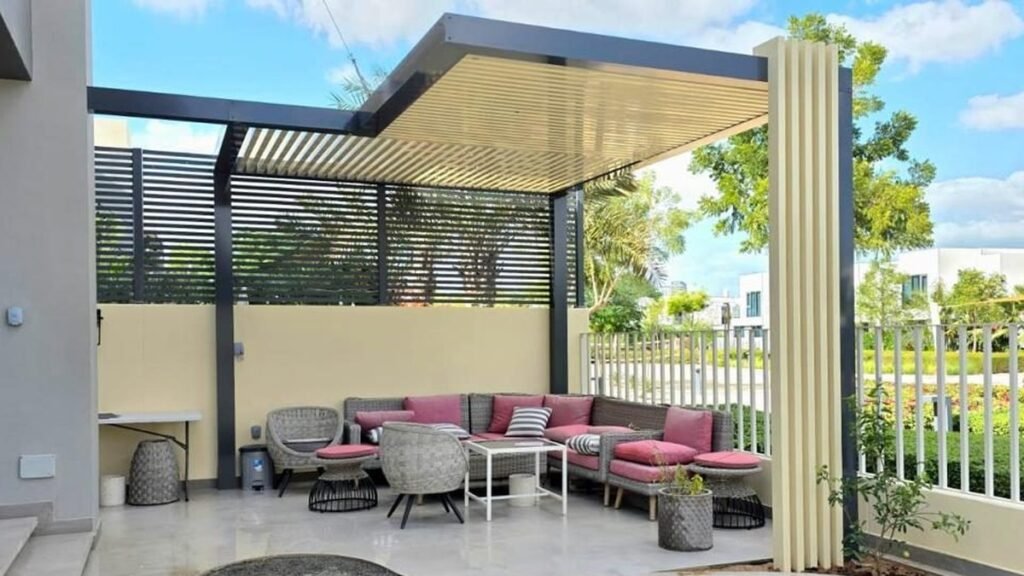
Dubai has roughly seven months of genuinely usable outdoor weather. The villas that make the most of it are not the ones with the most expensive furniture. They are the ones where shade, cooking and the connection to the house were designed together instead of bolted on one at a time.
This covers the three decisions that matter most: how you shade the terrace, how you build an outdoor kitchen that survives, and how you connect it all to the interior.
Shade: pergola, solid roof or sail
| Best for | Watch out for | |
|---|---|---|
| Aluminium louvred pergola | Control. Angle the blades for shade, close them for rain, open them in winter. | Highest cost. Motors and drainage need maintenance access designed in. |
| Fixed aluminium or steel pergola | Value and durability. No moving parts to fail. | Fixed shade angle, so orientation has to be right first time. |
| Solid roof extension | Full weather protection and the option of fans, lighting and cooling. | Almost always a permit and a setback issue. Can darken interior rooms behind it. |
| Shade sail | Lowest cost, quick to install. | UV degrades fabric, tension needs resetting, and it looks temporary because it is. |
| Timber pergola | Warmth and appearance. | Dubai sun and humidity are hard on timber. Expect real maintenance every year or two. |
The material point that matters most: powder-coated aluminium is the default here for good reason. It does not rust, it does not warp, and a good powder coat holds its colour under UV far better than paint on steel. If someone quotes mild steel, ask specifically how it is treated and what the warranty covers.
Orientation beats size. A west-facing terrace takes the worst of the afternoon heat. Shading it properly matters more than making it bigger. If the terrace faces north, you may need far less structure than you think.
Outdoor kitchens and BBQ counters
The failure pattern for outdoor kitchens in Dubai is predictable, and it is almost always the carcass rather than the appliances.
Build the carcass from blockwork or marine-grade stainless, not standard kitchen carcassing. MDF and chipboard units fail within a couple of summers. Heat, humidity and the occasional wash-down destroy them from the inside and you do not see it until a door falls off.
Worktops. Granite and porcelain handle UV and heat well. Quartz is the common mistake: many engineered quartz products discolour under sustained direct sun, and most manufacturers exclude outdoor use from the warranty. Check the specific product before agreeing to it.
Hardware. Use 316 grade stainless, not 304, anywhere near a pool. Chlorine and salt air will pit 304 and it looks poor quickly.
Services. Water, drainage, gas and power all need designing in from the start. Adding drainage to a finished counter means cutting the terrace. Gas in particular has its own approval requirements.
Position it for the wind. An outdoor kitchen placed upwind of the seating puts smoke over your guests every time. It sounds obvious and it is the single most common layout error.
Bi-fold doors: connecting inside to outside
A pergola and a terrace only work if the house opens onto them properly. This is where bi-fold and large sliding doors earn their cost.
Bi-fold versus sliding. Bi-folds stack the panels to one side and give you a genuinely open wall, which is the point. Large sliders give you bigger uninterrupted glass when closed but always leave at least one panel in the opening. If the open feeling is what you want, bi-fold. If the view when closed matters more, slider.
Specify thermally broken frames. This is not optional in Dubai. A non-thermally-broken aluminium frame conducts outside heat straight into the room, drives up cooling costs and can produce condensation on the frame in humid months. It is the difference between a door that works here and one that does not.
Glazing. Double glazing with a solar control or low-E coating. The coating does more for comfort than the second pane in this climate, because the problem is radiant heat, not cold.
Thresholds. A flush threshold looks far better and makes the terrace feel like part of the room. It needs proper drainage design so driven rain does not come inside. Ask how the drainage is handled before agreeing to flush.
Sand. Bottom-rolling tracks collect sand and grit. Whatever system you choose, ask how it is cleaned and serviced, because that determines whether it still runs smoothly in three years.
What needs approval
Pergolas, outdoor kitchens and boundary changes are permanent structures and generally need permits, plus a developer NOC in most communities. Setbacks commonly require around 1 metre from side boundaries, 1.5 metres from the front and 2 to 3 metres from the rear, though this varies.
Replacing doors within an existing opening is usually straightforward. Widening the opening is structural. The full picture is in our guide to villa renovation permits in Dubai.
Sequencing, if you are doing all three
- Decide the layout and where the sun and wind actually come from, on site, at the time of day you will use it.
- Get approvals for the permanent structures.
- Run services first. Power, water, drainage and gas go in before any paving or terrace finish.
- Build the pergola and counter.
- Change the doors, and coordinate the threshold level with the terrace finish.
- Finish surfaces, lighting and planting last.
Doing it in this order avoids the two most expensive mistakes: cutting a finished terrace to add drainage, and discovering the new door threshold does not line up with the paving.
Frequently asked questions
Do pergolas need a permit in Dubai?
Generally yes, as a permanent structure, along with a developer NOC in most communities. Height and setback limits vary, so check your community guidelines before designing.
Is a louvred pergola worth the extra cost?
If the terrace is the main outdoor space and faces west or south, usually yes, because you control the shade through the day and can close it against rain. On a north-facing terrace used mainly in winter, a fixed structure often does the job.
Can I use my normal kitchen supplier for an outdoor kitchen?
Only if they build a proper outdoor carcass. Standard indoor units will not last here. Ask what the carcass is made of and what the warranty says about outdoor installation.
Are bi-fold doors practical in Dubai heat?
Yes, provided the frames are thermally broken and the glass has a solar control coating. Without those two things the room behind becomes expensive to cool.
Planning your outdoor space
The best outdoor spaces get designed once, with the services, the shade and the doors resolved together. Retrofitting any one of them into finished work is where budgets go.
We handle pergolas, outdoor kitchens, doors and terraces as one scope under outdoor renovation, and coordinate them with any interior work happening at the same time.
Pingback: Landscaping a Dubai Villa Garden: What Actually Survives the Summer - Perfect Choice Renovation - Homepage