
Most Dubai villa gardens are designed in February and judged in August. That is the whole problem. A planting scheme that looks generous in spring can be brown, sparse and expensive to water by mid-summer.
This is what actually holds up through a Dubai summer, what the rules require, and where the money really goes.
Start with water, not with plants
Irrigation is the single biggest determinant of whether a garden survives, and the biggest ongoing cost. Design it first.
Drip, not spray, for beds. Spray irrigation in Dubai loses a large share to evaporation before it reaches the soil, and wets foliage in a way that encourages disease. Drip lines deliver water at the root.
Zone by water need. Lawn, shrubs and palms want different amounts on different schedules. Putting them on one valve means something is always either drowning or dying.
Water before dawn. Early morning, roughly 4 to 6 am, gives the lowest evaporation loss and lets foliage dry through the day.
A backflow preventer is required to protect the municipal supply. This is a compliance item, not an upgrade.
Keep runoff on your plot. Water must not discharge onto roads or storm drains, and pool backwash definitely must not. Submissions get rejected over drainage more often than over planting.
Soil is the hidden cost
Most Dubai plots are sand with very little organic content and often high salinity. Plants put into unamended sand do not fail immediately, they fail in year two, which is why the problem is so often blamed on the wrong thing.
Proper bed preparation means excavating to a real depth, replacing with a blended topsoil and organic matter, and ensuring drainage. It is unglamorous and it is the difference between a garden that establishes and one that limps. If a landscaping quote seems notably cheap, this is usually the line that is missing.
Planting that survives
| Type | Reliable choices | Notes |
|---|---|---|
| Palms and trees | Date palm, Ghaf, Neem, Damas | Ghaf is native and extremely tough. Mature Ghaf is protected and cannot simply be removed. |
| Flowering colour | Bougainvillea, Frangipani, Oleander, Hibiscus | Bougainvillea gives the most colour for the least water. Oleander is toxic, so avoid it where children or pets play. |
| Structure and hedging | Ficus nitida, Carissa, Tecoma | Ficus roots are invasive. Keep it well away from pools, drains and boundary walls. |
| Ground and texture | Lantana, Ruellia, ornamental grasses, succulents | Far lower water demand than lawn and holds interest through summer. |
| Lawn | Paspalum, Bermuda | Paspalum tolerates salinity and treated water better. Any lawn is the thirstiest thing in the garden. |
The honest advice on lawn: keep it small and put it where you actually use it. A modest, well irrigated lawn beside the terrace looks better year round than a large one struggling to stay green. Replacing the rest with planted beds, gravel and paving cuts water use and maintenance substantially.
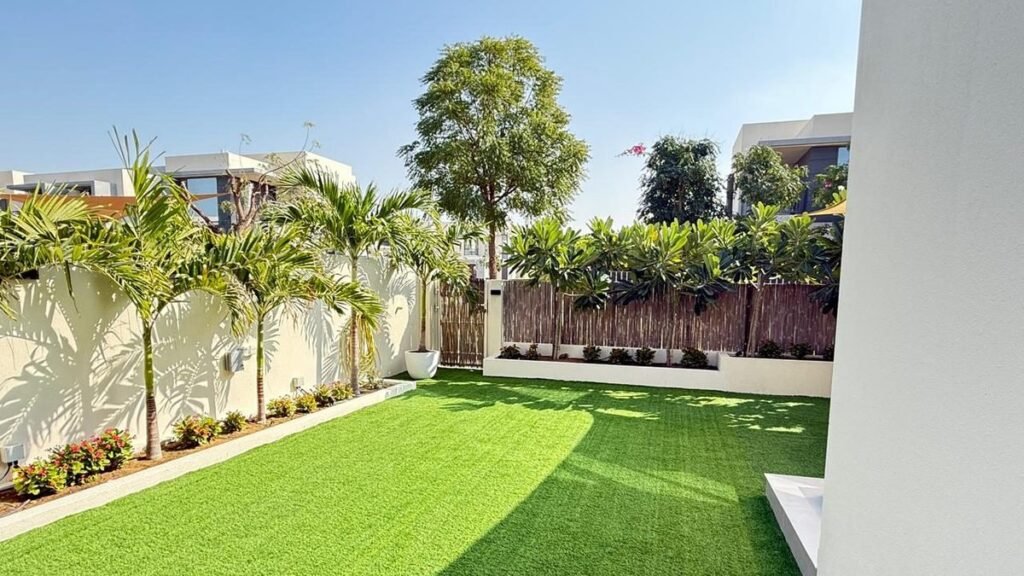
On artificial grass: it solves the water problem and creates a heat one. In direct Dubai sun it gets far too hot to walk on barefoot in summer. It works in shaded areas and on small terraces. It does not work as a large open lawn replacement in full sun.
Shade is a design element, not an afterthought
A garden with no shade is unusable for months. Trees take years, so most villas need built shade as well. Where the shade goes should be decided by where you sit in the late afternoon, not by where it looks balanced on a plan.
Shade also reduces the water demand of everything planted beneath it, so it pays back twice. We cover structures in detail in our guide to pergolas, BBQ counters and bi-fold doors.
What needs approval
Planting a bed does not need a permit. Most of the rest of a landscaping project does.
- Pools, water features, pergolas, gazebos and outdoor kitchens
- Boundary wall changes and retaining walls
- Major irrigation work and anything affecting drainage
- Removing protected trees. Penalties for mature Ghaf reportedly start at AED 10,000 per tree
Setbacks apply to permanent structures, commonly around 1 metre from side boundaries, 1.5 metres from the front and 2 to 3 metres from the rear, varying by community. Many communities also have their own rules on boundary treatments and planting.
Maintenance, honestly
A Dubai garden is not low maintenance. Irrigation needs checking monthly, because a blocked emitter kills a plant silently. Beds need feeding, since sandy soil holds nutrients poorly. Palms need periodic pruning. Salt builds up in soil over time and needs flushing.
Design for the maintenance you will realistically do. A simpler scheme kept well beats an ambitious one that is neglected by the second summer.
Frequently asked questions
What is the best time of year to landscape in Dubai?
October to March. Planting establishes far more reliably in cooler months. Anything planted in June needs considerable care to get through its first summer.
Do I need approval to landscape my villa garden?
For planting alone, generally not. For pools, pergolas, boundary changes, retaining walls or significant irrigation and drainage work, yes, plus a developer NOC in most communities.
Is artificial grass a good idea?
In shaded areas and small terraces, yes. In full sun it becomes too hot to use comfortably in summer, which defeats the purpose.
How much water does a villa garden use?
It depends almost entirely on how much lawn you have and whether irrigation is zoned properly. Reducing lawn area and moving beds to drip are the two changes that cut the bill most.
Designing a garden that lasts
The gardens that still look good in their third summer got the irrigation, the soil and the shade right at the start, then chose plants to suit. Doing it the other way round is why so many are replanted within two years.
We design and build gardens as part of our outdoor renovation work, including irrigation, drainage, hardscaping and approvals.